

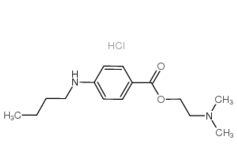
盐酸丁卡因
化合物简介
Tetracaine (also known as amethocaine) is a local anesthetic of the ester anesthetic group. It is mainly used topically in ophthalmology and as an antipruritic, and it has been used in spinal anesthesia.
In biomedical research, tetracaine is used to alter the function of calcium release channels (ryanodine receptors) that control the release of calcium from intracellular stores. Tetracaine is an allosteric blocker of channel function. At low concentrations, tetracaine causes an initial inhibition of spontaneous calcium release events, while at high concentrations, tetracaine blocks release completely.
Tetracaine is the T in TAC, a mixture of 5 to 12 per cent tetracaine, 0.05 per cent adrenaline, and 4 or 10 per cent cocaine hydrochloride used in ear, nose & throat surgery and in the emergency department where numbing of the surface is needed rapidly, especially when children have been injured in the eye, ear, or other sensitive locations.
It is on the World Health Organization’s List of Essential Medicines, a list of the most important medication needed in a basic health system.
A systematic review investigated tetracaine for use in emergency departments, especially for IV cannulation in children, in view of its analgesic and cost-saving properties. However, it did not find an improvement in first attempt cannulations.
In biomedical research, tetracaine is used to alter the function of calcium release channels (ryanodine receptors) that control the release of calcium from intracellular stores. Tetracaine is an allosteric blocker of channel function. At low concentrations, tetracaine causes an initial inhibition of spontaneous calcium release events, while at high concentrations, tetracaine blocks release completely.
Tetracaine is the T in TAC, a mixture of 5 to 12 per cent tetracaine, 0.05 per cent adrenaline, and 4 or 10 per cent cocaine hydrochloride used in ear, nose & throat surgery and in the emergency department where numbing of the surface is needed rapidly, especially when children have been injured in the eye, ear, or other sensitive locations.
It is on the World Health Organization’s List of Essential Medicines, a list of the most important medication needed in a basic health system.
A systematic review investigated tetracaine for use in emergency departments, especially for IV cannulation in children, in view of its analgesic and cost-saving properties. However, it did not find an improvement in first attempt cannulations.
基本信息
- 中文名称:
- 盐酸丁卡因
- 中文别名:
- 潘托卡因;
丁卡因盐酸盐;
4-(丁氨基)-苯甲酸-2-(二甲氨基)乙酯盐酸盐;
對卡因;
- 英文名称:
- Tetracaine hydrochloride
- 英文别名:
- Benzoic acid, 4-(butylamino)-, 2-(dimethylamino)ethyl ester, monohydrochloride;
4-(Butylamino)benzoic acid 2-(dimethylamino)ethyl ester,Ameth;
Tetracaine (hydrochloride);
Tetracaine HCl;
curtacain;
查看更多英文别名
- CAS号:
- 136-47-0
- 分子式:
- C15H25ClN2O2
- 分子量:
- 300.82400
- 精确质量:
- 300.16000
- PSA:
- 41.57000
- LogP:
- 3.49200
物化性质
- 外观与性状:
- 白色或灰白色结晶粉末
- 熔点:
- 149°C
- 沸点:
- 389.4ºC at 760 mmHg
- 闪点:
- 189.3ºC
- 稳定性:
- Stable at normal temperatures and pressures.
- 储存条件:
- Keep tightly closed.
- 蒸汽压:
- 2.87E-06mmHg at 25°C
安全信息
- 包装等级:III
- 危险类别:6.1
- 海关编码:2942000000
- 危险品运输编码:2811
- 危险类别码:R25; R36; R43
- 安全说明:S26-S36/37-S45-S36/37/39-S22-S53
- RTECS号:DG4900000
- 危险品标志:T
生产方法及用途
查看全部
用途
1、局部麻醉药。
2、局麻作用比普鲁卡因强,毒性亦较大,能透过粘膜,主要用于粘膜麻醉。
